
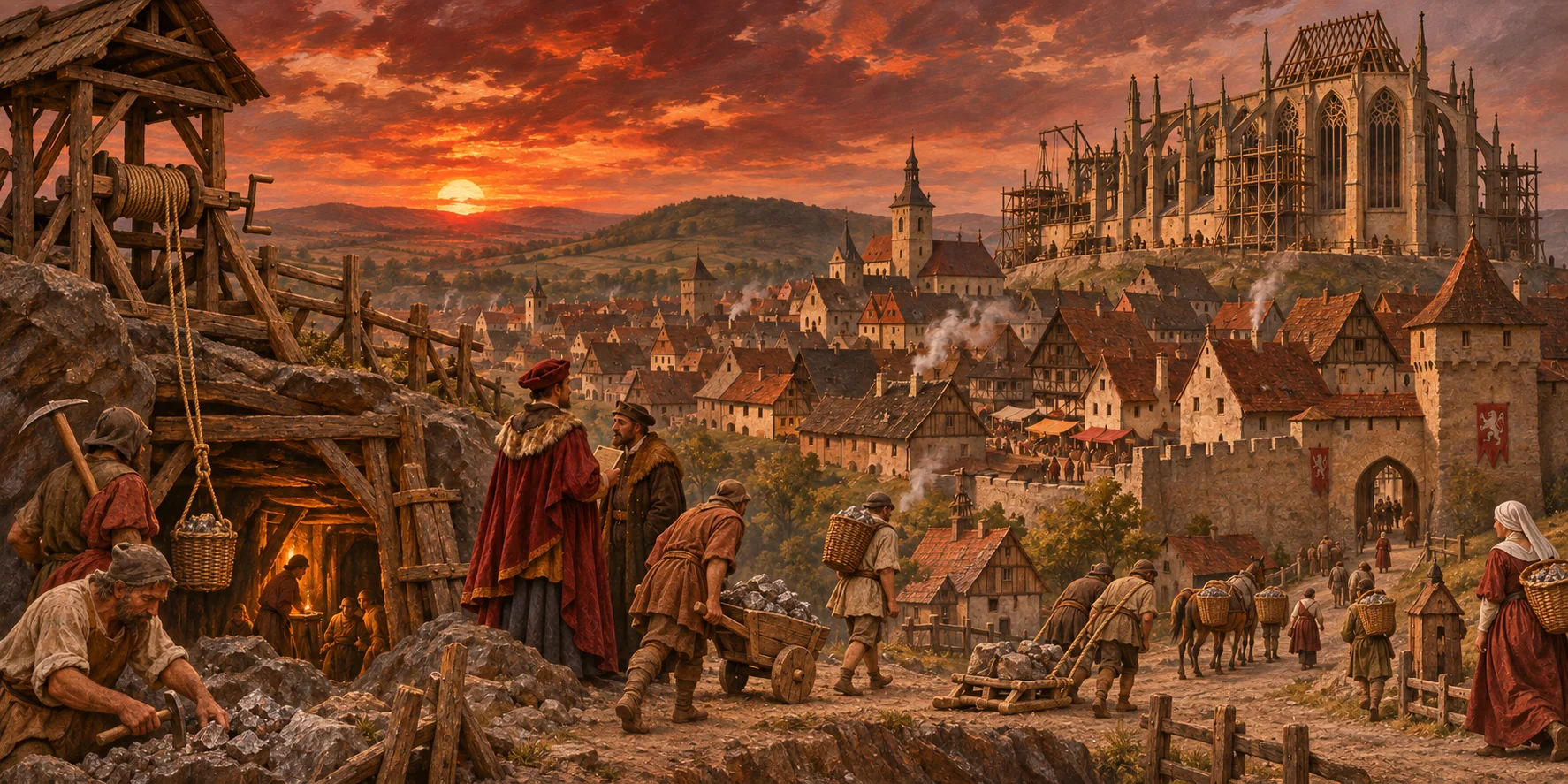
The wealthy mining town supported King Sigismund. Žižka’s army fought here in the winter of 1421–1422.
Town timeline
- 1289
The name Mons Cuthna is recorded. The town grew out of mining settlements.
- 1300
Wenceslas II issues the mining code and reforms the coinage.
- 21.–22. 12. 1421
Fighting near Kutná Hora and a change of control
- 6.–7. 1. 1422
The town burns after Žižka’s return
Control and government, 1400–1471
- 1400–1419
A royal mining town under Wenceslas IV, governed by councillors with royal officers overseeing silver and the mint.
- 1420–1421
The town is aligned with Sigismund, then switches to the Hussites in spring 1421 and admits Sigismund again in December.
- 1422–1434
The town community is allied with the Hussite field armies.
- 1435–1471
A royal mining town with a civic administration and royal mint. Sigismund confirms its privileges in 1437 and George reforms the coinage in 1469.
In the Hussite Wars
Control changed repeatedly in 1421: the city joined the Hussite side in the spring, Sigismund entered around Christmas, and Žižka drove him out in January 1422.
Discover the town
Silver from Kutná Hora’s mines and the royal mint at the Italian Court tied the town to the kingdom’s economy. Its wealth and position made it strategically significant during the war.
Places that shaped the town
The church of St Barbara recalls the town’s wealth. Work began in the late fourteenth century and the building remained incomplete during the Hussite Wars.
The town and the game’s world
Mines, coinage and trade show why towns were more than points on a map. Their wealth and supply routes shaped the fortunes of the wider region.
